
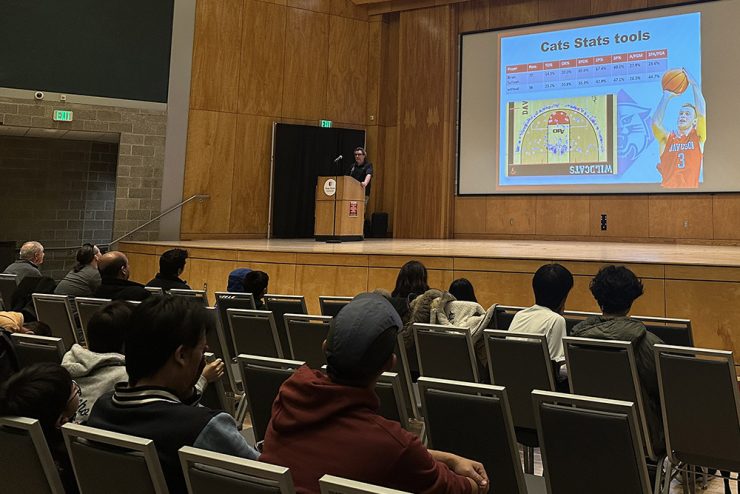

Mathematician, computer scientist and sports analytics expert Tim Chartier led an audience in the Student Activities Center auditorium into the fast-moving world where data meets athletics in the latest installment of Stony Brook University’s Convergence Lecture Series.
Presented by the Institute for Creative Problem Solving (ICPS) in partnership with the National Museum of Mathematics (MoMath) and Brookhaven National Laboratory, the November 22 lecture blended humor, storytelling and real-world examples to show how mathematical thinking is transforming modern sports.
ICPS is a tuition-free STEM program for gifted students in grades 5–10 across Long Island, now newly housed at Stony Brook after relocating from Brookhaven National Laboratory. The program draws students from Suffolk, Nassau, Queens and beyond, and is staffed by instructors from across the region. Earlier in the day, Chartier led a discrete-modeling workshop for ICPS graduates enrolled in higher-level courses, emphasizing approximation over exactness. This approach aligned seamlessly with the themes of his public talk.
Chartier, whose consulting portfolio spans the NFL, NBA, NASCAR, ESPN and The New York Times, was introduced by MoMath’s CEO Cindy Lawrence, who recalled meeting him during the museum’s earliest planning stages. “He immediately had ideas and joined our advisory council and literally helped us build the original MoMath,” she said, noting that his expertise spanned all kinds of fields, even being a trained mime and puppeteer.
 Taking the stage, Chartier opened with a mix of candor and energy. “I’ve been to MoMath so many times,” he joked, “but all I need is one or two months away, and when I walk in, it’s the closest thing to being in Willy Wonka’s Candy Land.”
Chartier’s path into sports analytics began with three Davidson College students who walked into his office years ago and asked if they could build statistical models for the men’s basketball team. He said yes before knowing whether they could produce anything useful.
“But by mid-season, the coaches were reliant on what would go on their desk after each game,” he said.
The experiment evolved into CatStats, a student-run analytics group that now informs coaching strategies across multiple Davidson teams. Alumni have gone on to professional sports and high-level data roles; some have worked with NBA teams and won major analytics competitions.
What drives Chartier isn’t just athletics, he said, but the stories inside of them: “I’m more interested in the human drama of it.”
Throughout the lecture, Chartier emphasized one message for aspiring analysts: start now. Perfect datasets aren’t required.
“The best way to work in sports analytics is the Nike approach: just do it,” he said. Coaches and employers care more about the quality of questions than the size of the dataset.
He walked students through simple ways to gather sports data, from spreadsheets to Google Sheets’ IMPORTHTML function to basic scraping. He and his students were hired by the U.S. Olympic & Paralympic Committee for a scraping project. “You can ask a lot of great analytics questions, and I believe you’re a sports analyst even if you just ask the question,” he said.
One of the most delicate parts of the job, he noted, is communicating findings. “People listen with the lens they have,” he said. Learning how a coach thinks, what they track, worry about and dismiss, is part of the analytical process.
He described sitting courtside at the Barclays Center during the Atlantic 10 basketball tournament while The New York Times shadowed him. When a fan behind him commented, “We’re playing their game,” he asked her to explain. Her observation about pace sparked a quick analysis he texted to his students: proof, he said, that analytics often begins with a sharp, simple question.
For some students, analytics becomes a doorway into sports; for others, a doorway into math itself. He shared how a movement-artist friend, once disconnected from mathematics, now hosts a March Madness bracket-building session each year using models Chartier taught him. “That was one of the first times he sat at the dinner table and ever talked math with his kids,” he said.
The event closed with audience questions on career paths and scraping techniques, and a final encouragement to experiment, explore and email him with ideas. “If I don’t reply,” he said, “email me again.”
— Lily Miller






Add comment