

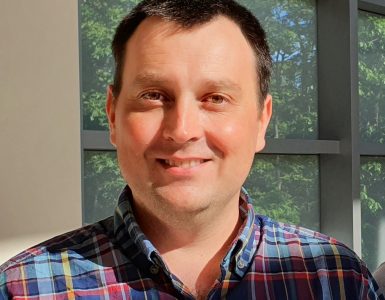
Katherine Skinner is a new associate professor in Stony Brook University’s Department of Mechanical Engineering. She’s currently teaching a lecture course focusing on the application and challenges that come with marine robotics, spanning marine robot design, dynamics, planning and controls, and sensing and perception.
Skinner’s interest in underwater robotics started during her undergraduate internship at the Woods Hole Oceanographic Institution.

“During that internship, I got to do some hands-on field work. We went out on the boat and deployed an autonomous underwater vehicle,” Skinner said. “And it was just really exciting to see it dive below the water, and track its mission on our computer and then see it pop back up with the data that it collected.”
Her dive into this field was also influenced by where she grew up.
“I grew up on Long Island, surrounded by water. I grew up fishing, and being able to combine my engineering coursework with being out on the water was a really great opportunity.”
Skinner went to Princeton for her undergraduate degree, where she majored in mechanical and aerospace engineering. She then completed her master’s and PhD at the University of Michigan’s Robotic Institute during its first year of operation. During that year, she was one of only eight other students enrolled in the program.
“It was really interesting because we were the first students, we got to see how things worked within the program,” she said. “And the faculty gave us a chance to really affect how the program evolved. When I went back as faculty, it was cool to see that the robotics program had grown an incredible amount, and even had its own building that I could move into as faculty.”
After working as an assistant professor of robotics at the University of Michigan, Skinner sees opportunity at Stony Brook University, even though there is not a dedicated Department of Robotics.
“There’s robotics coursework across different departments in the College of Engineering, so I’m hoping this is a good opportunity to come together and build collaboration in robotic research, but also in robotics education, too.”
Skinner’s research focuses on underwater robotics to produce high-resolution 3D models of underwater environments. To accomplish this, she has to restore images taken of structures on the sea floor, so she can create the most accurate models possible.
“Underwater images — if you’ve gone scuba diving and taken pictures — they’re kind of a blue-green color, and that’s something that is very unique to underwater imaging that we account for when we design our algorithms for marine robotics,” she said.
Her hope is to have her models aid research in marine biology and marine archeology, with a particular interest for shipwreck reconstruction.
“Shipwrecks are really interesting from a robotics perspective because they are very complex and varied sites. There’s challenges from the perception side because it’s a complex structure that can change over time in the environment. So I’m hoping to continue that work here and study some shipwrecks around Long Island.”
Skinner is passionate about how much collaboration her research allows with other fields of study.
“Being able to work in such an interdisciplinary environment and build tools for archaeologists that might be useful to them has been really rewarding. A big part of my work is making sure that the research we developed can be used by others.”
One of these tools Skinner’s research helped develop for marine archaeologists is a GIS (Geographic Information System) software for shipwreck detection, using multi-beam sonar data.
“I’ve always tried to, when possible, release code open source. Because collecting data for marine robotics applications can be really challenging and expensive, and this can limit accessibility to working in the field of marine robotics.”
Skinner is now teaching a class to help mentor students who have an interest in marine robotics, as well as working with student design teams in her lab to build new marine robots and field test them in the water.
“My goal in the next couple of years is really to build a strong marine robotics group in the mechanical engineering department. Also in terms of education, being able to introduce students to the field of marine science, especially at the undergraduate level.”
— Mattia Stradella




Add comment