More than 200 people flooded into the Wang Center Theater to hear inventor, social entrepreneur and mathematician Po-Shen Loh speak on AI and the future.
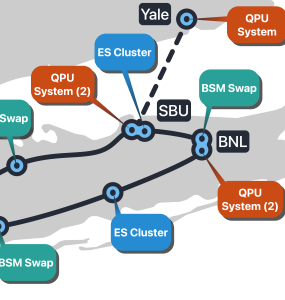
A Stony Brook University-led team has been awarded a National Science Foundation (NSF) grant supporting the National Quantum Virtual Laboratory (NQVL) Quantum Testbeds. Stony Brook’s award funds a project called SCY...
The Office of Brookhaven National Laboratory (BNL) Affairs has announced the winners of the SBU-BNL Seed Grant Program, with nine awards totaling nearly $600K.
Stony Brook University President Andrea Goldsmith delivered the keynote at the Brookhaven National Laboratory internship and summer programs graduation.
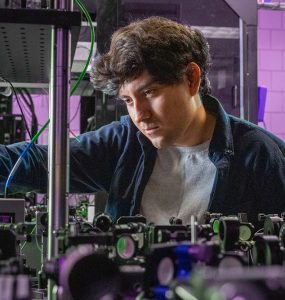
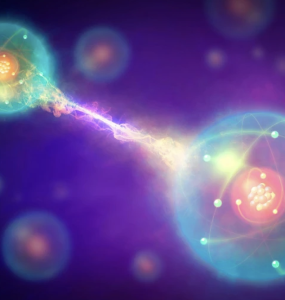
At Stony Brook University and Brookhaven National Laboratory, the challenges of quantum technology are being tackled head-on through real-world experiments.
A team of scientists from Stony Brook University and Brookhaven National Lab used artificial intelligence to help understand how batteries can be more efficient
For nearly three decades, Stony Brook faculty and students have advanced scientific discovery through a collaborative relationship with Brookhaven National Lab
Physicists at Brookhaven National Laboratory and Stony Brook University have shown that particles retain information about their origins in subatomic smashups.
A study conducted by researchers at Brookhaven National Laboratory and Stony Brook University explains how different cloud types can impact solar forecasting
The Quantum Networks Town Hall was a component of Stony Brook University’s quantum science collaboration with Columbia, Yale and Brookhaven National Laboratory.
Stony Brook University physicists led a new analysis of data from the PHENIX experiment at the Relativistic Heavy Ion Collider at Brookhaven National Laboratory
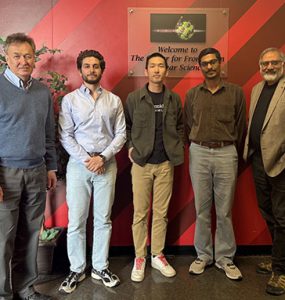
Pallavi Surana and Varun Ravi Kankanallu, doctoral students at Stony Brook University, are the recipients of the 20th annual Mow Shiah Lin Scholarship.
Scientists, including Stony Brook University Professor of Physics and Astronomy Dmitri Kharzeev, are using data from particle smashups to peer inside protons.
Stony Brook University researchers working at Brookhaven National Laboratory have developed a new theoretical framework for predicting the behavior of catalysts
Two Stony Brook University geosciences professors are part of a consortium that has received $50 million from the U.S. National Nuclear Security Administration