
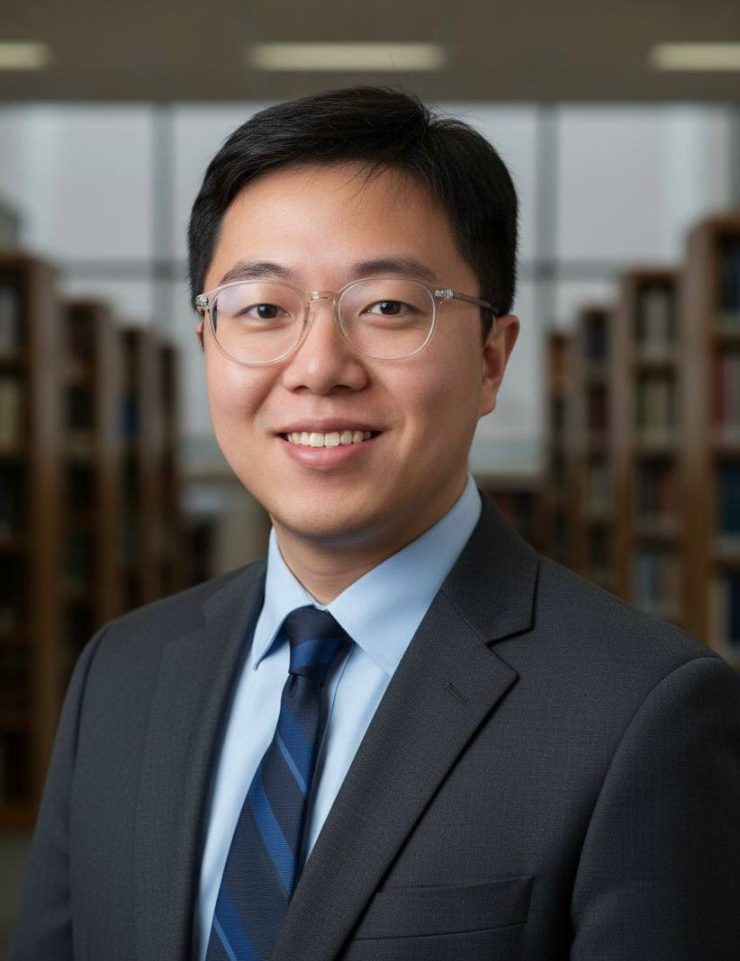
How can AI help scientists design better molecules and next-generation batteries? Stony Brook University researcher Yi Liu is tackling this question through two related efforts: a three-year, $622,471 NSF project rebuilding generative AI to create new molecules, and a collaborative project with BNL researchers to explore AI and ML approaches for the design and optimization of battery electrolytes.
Yi Liu, core faculty member at Stony Brook’s AI Innovation Institute and assistant professor in the Departments of Applied Mathematics & Statistics and Computer Science, has worked at the intersection of AI and biology, chemistry and materials science for close to a decade.
He now leads a three-year $622,471 NSF project, “Collaborative Research: III: Advanced Diffusion Models for Molecular Graph Generation,” developing generative AI models for creating molecules in collaboration with Shuiwang Ji at Texas A&M University. At Stony Brook, the project involves his PhD students Jingxiang Qu and Fang Wan, as well as his recently graduated PhD student Wenhan Gao, who is now a research scientist at Meta.
A collaborative effort is also underway between Liu’s group at Stony Brook University and Enyuan Hu’s group at Brookhaven National Laboratory (BNL). Liu and Hu are co-advising research that explores how AI and machine-learning methods can accelerate the development of advanced battery electrolytes. The work combines literature mining, molecular screening, property prediction and experimental validation, with a particular focus on electrolyte materials for lithium- and sodium-based batteries.
“Battery research has a long published record,” Liu says. “We didn’t want to start something new without knowing what others are working on.” So the collaboration began with literature mining.
The team has now developed a web-based system that processes published papers on the subject, drawing evidence from across formats and turning scattered information on formulations, experimental conditions and performance into structured, verifiable records. “The goal was to turn labor-intensive literature review into a scalable and repeatable scientific data pipeline while keeping researchers in the loop to verify the extracted evidence.”
Read the full story at the AI Innovation Institute website.



Add comment