

Universities, industry leaders and government partners from across New York State convened November 12-13 at the SUNY Global Center in New York City for the annual State University of New York Research Council meeting, a two-day forum exploring how strategic collaboration drives innovation and economic growth.
This year’s theme, “Strategic Partnerships for Innovation: Advancing Regional Impact through Academic-Industry Collaboration,” underscored the role of public universities as catalysts for research that fuels job creation, startup activity and regional prosperity.
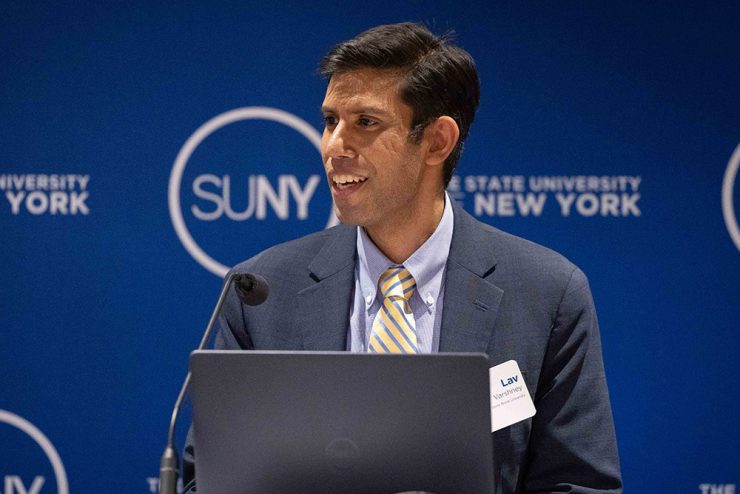
Stony Brook University played a leading role in this year’s discussions. Lav Varshney, director of the Stony Brook AI Innovation Institute, delivered the keynote address, sharing insights into the transformative potential of artificial intelligence as both a scientific frontier and a driver of national competitiveness.
“We need to pursue both innovation in AI and its diffusion across industries and society,” said Varshney, who is also the Della Pietra Infinity Professor in the College of Engineering and Applied Sciences Department of Electrical and Computer Engineering. “That combination of developing new algorithms and architectures while ensuring AI is safe, secure and trustworthy is how we strengthen our state and national competitiveness.”
His remarks positioned Stony Brook’s AI Innovation Institute as a hub for both foundational research and interdisciplinary collaboration spanning health sciences, arts and humanities, engineering, business and entrepreneurship. Varshney emphasized that the institute’s approach combines vertical advances in AI, such as new algorithms, architectures and theoretical foundations, with horizontal diffusion across disciplines, from medicine and dentistry to anthropology and the arts.
Varshney also emphasized that trust, safety and human understanding must remain central to the development and adoption of AI, calling them “the foundation for ensuring that innovation truly benefits society.”
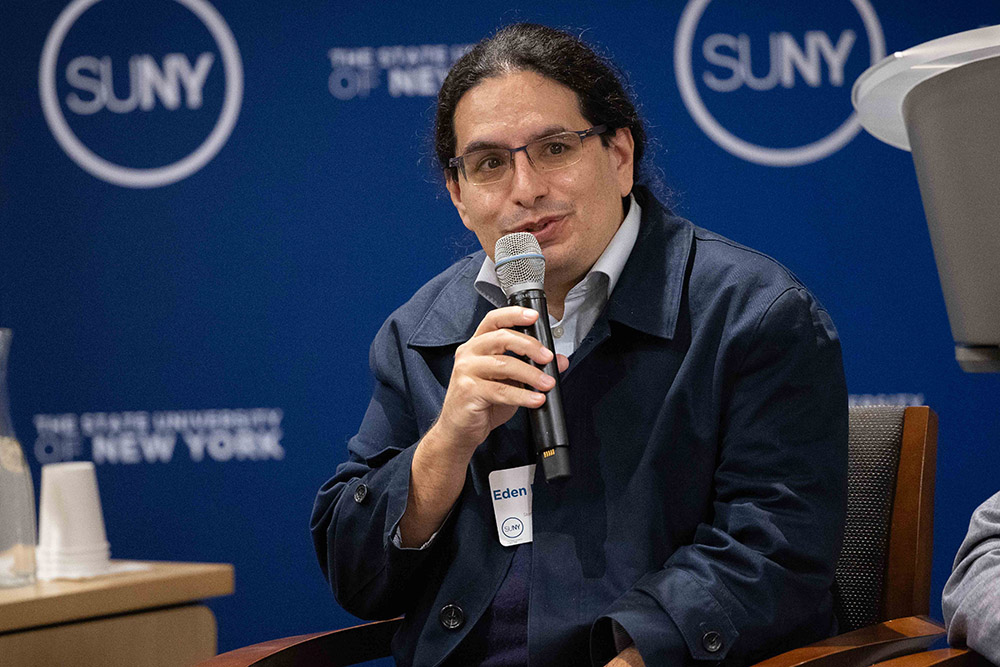
Eden Figueroa, director of the Center for Distributed Quantum Processing and Presidential Innovation Endowed Professor in the College of Arts and Sciences Department of Physics and Astronomy, was a panelist for a session titled, “Quantum New York: Advancing Regional Impact through Academic–Industry Collaboration.” It explored how New York’s expanding quantum ecosystem is uniting universities, national laboratories and industry partners.
Figueroa’s participation reflected his central role in shaping New York’s rapidly advancing quantum enterprise. He leads several cornerstone initiatives at Stony Brook, including the development of long distance quantum communication networks and next generation quantum repeater technologies that form the backbone of regional and national quantum infrastructure. His work also intersects directly with the state’s $300 million investment in the new Quantum Research and Innovation Hub at Stony Brook, where he is helping guide the scientific vision for a facility dedicated to quantum communication, computing and workforce development. Through these efforts, he has become a key link connecting university researchers, national laboratories and industry partners committed to accelerating quantum discovery and commercialization.
The conversation highlighted the momentum generated by New York State and Governor Kathy Hochul’s $300 million investment in quantum science and technology at Stony Brook. The participation of Stony Brook’s research leadership at the meeting signaled the flagship university’s strong alignment with industry-driven priorities: cross-sector collaboration, scalable regional impact and integrated academic-industry partnerships. The university recently launched the AI Innovation Institute (AI3) to “accelerate, coordinate and organize AI innovation and education across Stony Brook,” bringing together researchers across disciplines to harness AI for discovery and societal benefit.
The Quantum Research and Innovation Hub will establish a 150,000-square-foot facility dedicated to quantum communication, computing and workforce development. Together, these initiatives demonstrate how Stony Brook is aligning cutting-edge research in artificial intelligence and quantum science with the broader goal of strengthening the state’s innovation ecosystem and driving economic growth.
Kevin Gardner, vice president for research at Stony Brook, noted that the university’s leadership in AI and quantum research exemplifies how SUNY campuses can drive progress through collaboration. “We are at a crossroads where continued investment in research is essential not just for innovation but also for maintaining the technological leadership of the United States,” Gardner said. “Our collective efforts demonstrate how public universities can serve as engines of both discovery and economic vitality.”
The SUNY Research Council meeting reinforced the university system’s central role as a convener, bringing together researchers, policymakers and industry leaders to shape the future of New York’s innovation ecosystem. Through collaborative research in fields like artificial intelligence, quantum information science and advanced energy, Stony Brook and its SUNY partners continue to bridge academic excellence with societal impact, ensuring that New York remains at the forefront of scientific advancement and regional growth.
The SUNY AI Symposium at Stony Brook University will convene leading AI experts from across New York State and beyond from April 14-16, 2026. See more information about the symposium at stonybrook.edu/ai_symposium.




Add comment