
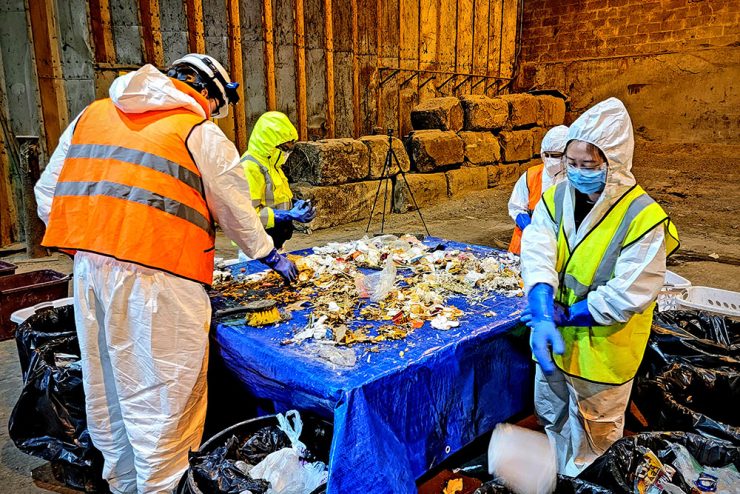
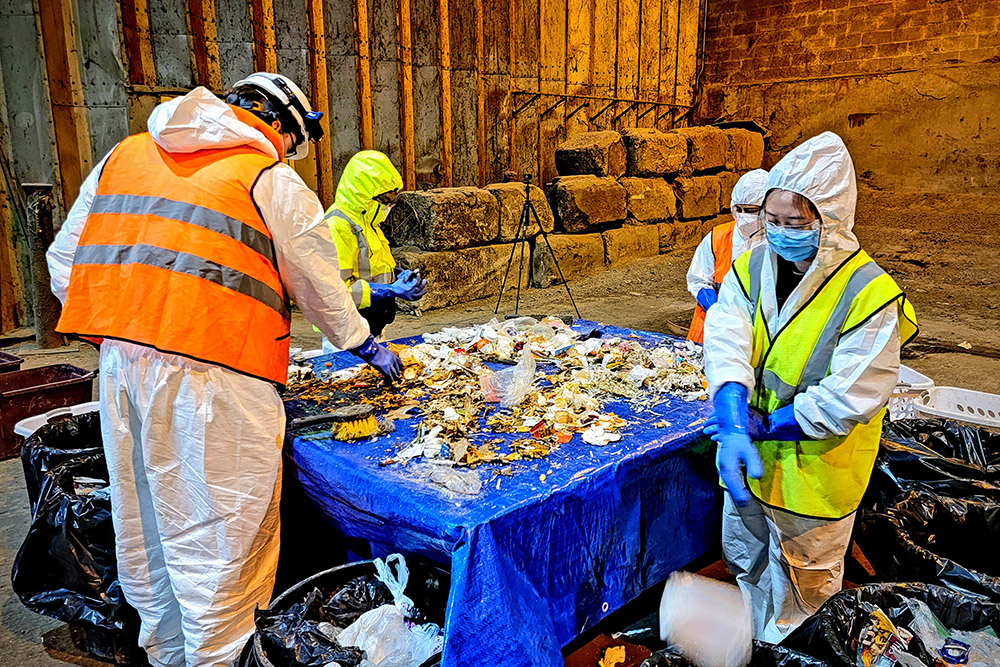
Recycling rates in New York State have stalled, prompting a detailed examination of what New York residents discard and recycle. Researchers at Stony Brook University’s Waste Data and Analysis Center are addressing this challenge by sorting and weighing municipal solid waste at facilities across the state to produce data that can guide waste management policy and practice.
“We want to identify what materials are being thrown away in the municipal solid waste and recyclable stream,” said Krista Thyberg, research assistant professor in the Department of Technology and Society and associate director of the Waste Data and Analysis Center. “Are the materials that are recycled acceptable materials, or are there contaminants in there that are not recyclable?”
The research is supported by an $8 million investment from the New York State Department of Environmental Conservation and is part of a 10-year project that began in 2019. The goal is to quantify how much waste is being disposed of across the state and to use that data to inform policy and promote more sustainable waste management practices.
“Once we really understand what is in our waste and recyclables streams,” Thyberg said, “we can move forward with data driven research to help develop policy recommendations.”
The project was launched under the leadership of David Tonjes, a research associate professor who directed the Waste Data and Analysis Center for several years before his recent retirement. Tonjes has spent more than three decades studying solid waste management in New York. Under his leadership, Stony Brook entered into a memorandum of understanding with the state that made the work possible.
Each year, the research team sorts waste at about 20 locations statewide. While the team does not conduct hands-on sampling in New York City, which has its own waste characterization program, it incorporates city data into some of its statewide analyses. On Long Island, the team has sorted waste in six municipalities across Nassau and Suffolk counties.
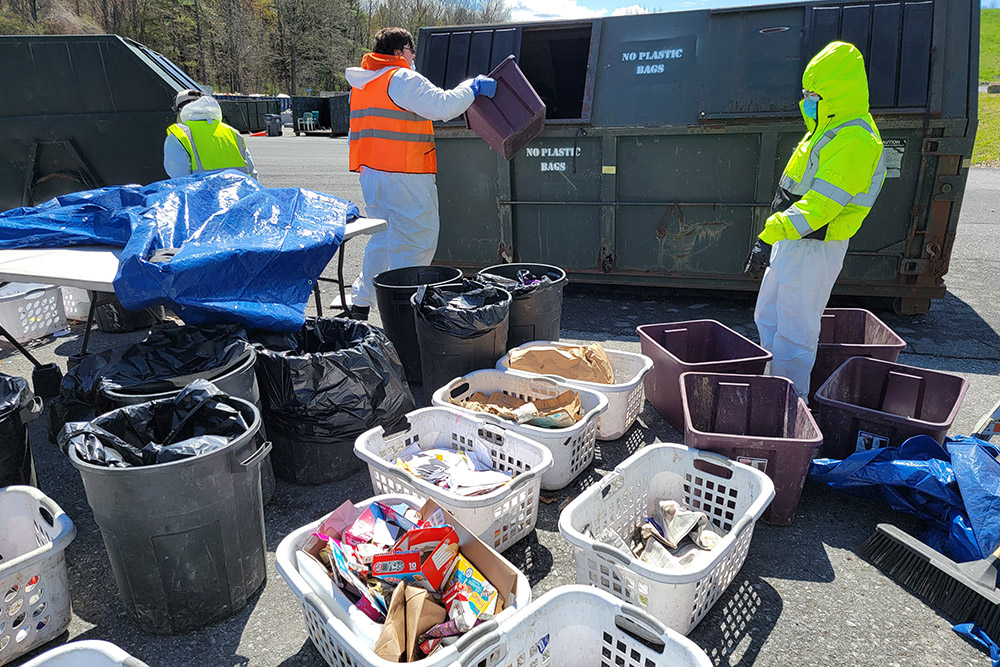
“We sample at 22 municipalities throughout New York State, upstate and across Long Island,” Thyberg said. “Our trained samplers go directly to the waste management facilities and hand sort three or four samples a day for three to five days at each site. Each sample is about 200 pounds.”
At each site, sampling typically lasts three to five days and takes place year-round. Summer is the busiest season, but the team works through all four seasons to capture variations in waste patterns.
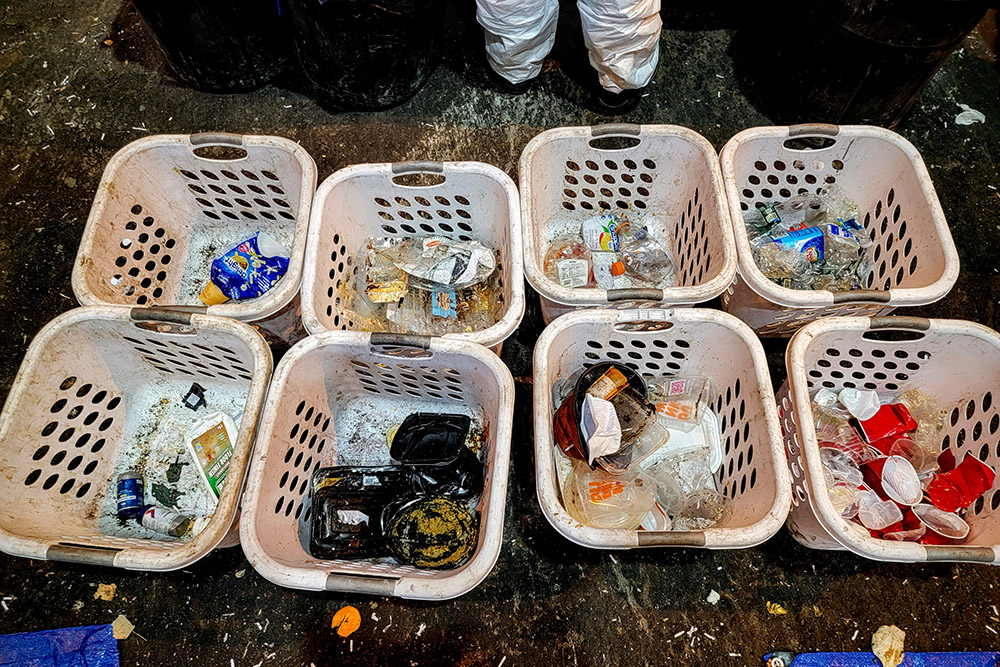
When the sorting begins, the waste is divided into 69 distinct categories, ranging from different types of paper and food waste to specific plastic containers.
“It’s a messy job,” Thyberg said, “but that level of detail is what allows us to really understand what is being disposed of and recycled.”
Across municipalities the composition of waste varies, but some trends remain consistent. Paper products, food waste and plastics make up the largest share of the waste stream statewide. The team also studies differences in recycling programs, comparing dual stream systems, where paper and containers are separated, with single stream systems, where all recyclables are collected together.
“We look at the percentages of each type of material, and there are variations from municipality to municipality,” Thyberg said. “We also compare different recycling programs to get a feel for which program type leads to more efficient collection and fewer contaminants.”
The data reveal widespread confusion around recycling, particularly when it comes to containers. At Long Island facilities, researchers found that roughly one third of glass, metal and plastic placed in recycling bins should not have been there.
Plastic containers are especially problematic; the numbering system used on plastics often leads residents to believe more items are recyclable than actually are.
“What we’re finding is that the paper recyclables are pretty well sorted,” Thyberg said. “Residents are doing a great job there. But the containers are much more confusing, and that’s where we see a lot of contamination.”
Based on statewide data from 2023, the team estimates that nearly 18 million tons of waste were disposed of in New York in a single year, yet Long Island residents are recycling only about 30 to 60 percent of what they could be recycling.
“If we did better, if we recycled everything we could, we would triple our recycling,” Tonjes said.
Those findings carry greater urgency as Long Island’s largest landfill approaches closure, making waste reduction and recycling essential to conserving resources and limiting environmental impact.
“What makes this work especially important is that municipalities get access to rigorous, empirical data,” said Elizabeth Hewitt, associate professor in the Department of Technology and Society and director of the center. “Many local governments simply don’t have the resources to conduct this kind of research on their own, and that data is essential for making smart waste management decisions.”
Beyond the numbers, the project also serves as a training ground for students and early-career researchers. Since 2019, 17 undergraduate and graduate students have worked on the project, gaining experience in every stage of applied research, from planning and field sampling to data analysis and reporting. Thyberg and Hewitt are assisted by Sampling Research Manager Firman Firmansyah and Sampling Program Manager Yiyi Wang, in cooperation with Associate Professor Ruwen Qin in civil engineering.
“They’re getting hands-on experience doing research from start to finish,” Thyberg said. “They help plan and prepare for the sampling, collect the data, analyze it and see how it gets reported back to municipalities and the state.” For Wang, the work has had a lasting professional impact. “Conducting hands-on waste sampling across New York State and analyzing real-world data showed me how critical applied research is to improving waste management systems,” Wang said. Firmansyah echoed that perspective, noting how the work reshaped his understanding of waste. “We all generate waste, but few of us track what we throw away,” he said. “This project showed me that to effectively reduce what we send to landfills, we must first be mindful of what we discard.”
Students also work alongside faculty researchers and full-time sampling specialists, gaining experience in collaborative, interdisciplinary teams.
“It’s a really good mix of people working together,” Thyberg said. “That’s a valuable experience for students.”
In addition to waste sorting, the grant supported the development of a cost modeling tool to help municipalities evaluate whether adding new recyclable materials is financially feasible. The team also completed a technology assessment of recycling facilities across New York and the country to examine emerging practices.
As Tonjes stepped back, Thyberg took on a larger management role, helping guide the project alongside Hewitt. Thyberg joined the effort in 2020, shortly after funding was secured.
“I came on to help get the project running,” she said. “After David Tonjes retired, I took on a larger role, and now we’re focused on continuing the work he started, helping communities to improve recycling efforts and waste less.”
— Beth Squire


Add comment