


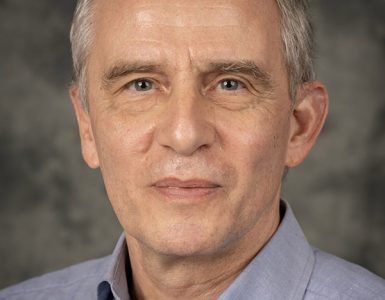
It took Stony Brook Medicine cardiologist On Chen, MD five years to write a textbook on electrocardiograms. Then an undergraduate student asked him if he had a three-dimensional model of the heart so that he could show students what happens when something goes wrong.
Chen didn’t. But the student returned a day later with one he had created using artificial intelligence. The interactive model allows users to simulate a blocked artery or administer medication and watch the resulting changes in an electrocardiogram and a patient’s vital signs.
“It took me forever to write a book,” Chen said. “If the student’s method is better than mine, by all means…”
Chen shared the story during The AI Revolution at Stony Brook: How Seawolves Are Deploying Artificial Intelligence Across All Facets of Our Mission, a presidential panel discussion held October 16 at the Charles B. Wang Center as part of the university’s inaugural Homecoming Thought Leadership Series.
Moderated by Stony Brook University President Andrea Goldsmith, the discussion brought together four SBU experts in education, engineering and medicine to explore how AI is changing their work, what it means for students and researchers and why human judgment still matters.
“Our responsibility, Stony Brook’s responsibility, is to ensure that this powerful technology not only strengthens each dimension of our mission, but also the communities we serve and society as a whole,” Goldsmith said.

The panelists were enthusiastic about AI’s possibilities, while they acknowledged that they do not have all the answers.
Rose Tirotta-Esposito, assistant provost of educational transformation and director of the Center for Excellence in Learning and Teaching, described faculty using chatbots for role-playing exercises, simulations and other activities that allow students to interact with course material in new ways. Other instructors are taking the opposite approach, redesigning assignments around group work and classroom discussions without AI.
“I think first we have to give ourselves a little grace during this time period,” she said. “We have to be willing to get out there and make mistakes with the classroom. We have to innovate. We have to try new things.”
Goldsmith worried that students who can get immediate answers from AI might stop visiting professors during office hours or working through difficult assignments with classmates. “I think all of us can think back on teachers that believed in us and that made a difference,” she said. Without those interactions, students could miss “that connection with the person that’s your role model and inspires you.”
Tirotta-Esposito suggested that AI could actually create more opportunities for meaningful conversations. Students might use the technology for basic questions outside classroom hours, leaving more time with instructors and tutors to discuss difficult concepts.
Cindy Lee, MD, chief of breast imaging in the Department of Radiology and vice chair of clinical research and faculty affairs at Stony Brook’s Renaissance School of Medicine, said students also need to recognize that AI’s confident answers aren’t necessarily accurate.
“The most confident answer is not always the correct one,” she said. “Because when you ask ChatGPT, oh, what should be the number one diagnosis in this case, it will give you a very confident answer that sounds right, but sometimes it’s just really wrong.”

Andrew Singer, dean of the College of Engineering and Applied Sciences, said preparing students for an AI-driven future means teaching them how to think, and not just how to use today’s technology. “If we only teach them how to use the technology that is today, ChatGPT, whatever level it is, well, then we’re setting them up for failure,” he said.
AI can help researchers build simulations and handle technical tasks that once required extensive preparation, but Singer said the technology raises questions about how universities evaluate research, particularly when producing a paper becomes considerably easier. “We as humans have to trust in our own ability to evaluate what is scholarship, evaluate what is original thought and research,” he said.
Lee acknowledged that AI has changed her perspective on academic work. Recently promoted to full professor after years of publishing papers and securing research grants, she joked about watching AI accomplish tasks that once took months. “I really feel like, what did I do with my whole life?” she said. “I really feel replaced. And it’s a scary reality.”
Yet Lee now considers AI an important partner in her research. “So I think AI is my best research collaborator today,” she said.
That prompted Goldsmith to ask whether universities would still need graduate students. “Absolutely,” Lee responded.
Goldsmith expressed concern that AI could reduce opportunities for graduate students to learn through introductory research assignments, particularly at a time when research funding is under pressure. Lee emphasized that mentoring the next generation of researchers remains essential, even as the tools they use change.

The discussion then turned to patient care, where AI is already part of daily work at Stony Brook Medicine.
Lee said Stony Brook’s breast imaging program has used AI since 2018. The technology can flag suspicious findings on mammograms, serving as a second set of eyes for radiologists. But physicians must still consider each patient’s medical history, family history and other risk factors before making decisions.
Her research is also examining whether AI performs equally well among patients from different racial and ethnic backgrounds. Through Stony Brook’s mobile mammography program, which brings screening services to underserved communities, researchers are studying how the technology performs in populations that have been underrepresented in previous research.
“I think the greatest potential for AI right now is to personalize patient care,” Lee said. “It’s giving the right care to the right patient at the right time.”
Chen, an associate professor of medicine in the Department of Medicine, recalled meeting with a patient who had used AI to find him and research potential treatments. The patient arrived with possible solutions, but the two still needed to discuss which ones were appropriate for his circumstances. “There’s a social awareness,” Chen said. “There is a part of the story that AI cannot extract from a patient.”
The panelists also addressed data privacy, regulation and the importance of maintaining human oversight as AI becomes more widely used. Lee rejected the idea that advances in the technology would eventually eliminate the need for physicians.
“I think AI is never going to replace us as humans or physicians,” she said.
Instead, Lee hopes it will give doctors more time for the work that matters most to patients.
“It’s here to make me a smarter, a faster, a better physician so I can spend more time, and I can be more human with my patients,” she said.

The Thought Leadership Series also included three events hosted by the College of Engineering and Applied Sciences, the College of Business and the College of Arts and Sciences.
College of Arts and Sciences Dean David Wrobel and the CAS Board of Advocates held a special live‑audience recording of The Difference You Make: The Ideas that Matter podcast. The panel provided an insightful conversation on leadership, impact and the enduring role of CAS.
The College of Business hosted “Taking the Leap: Courage, Risk and Opportunity in Business and in Life.” Interim Dean Julia Bear and accomplished COB alumni shared pivotal moments, risks and decisions that shaped their careers.
The College of Engineering and Applied Sciences hosted “AI and Society.” Yvette Wohn, inaugural chair of the new Department of Technology, AI and Society, provided an engaging look at how artificial intelligence and emerging technologies are reshaping the way we live, work, interact and connect.
— Beth Squire





Add comment