
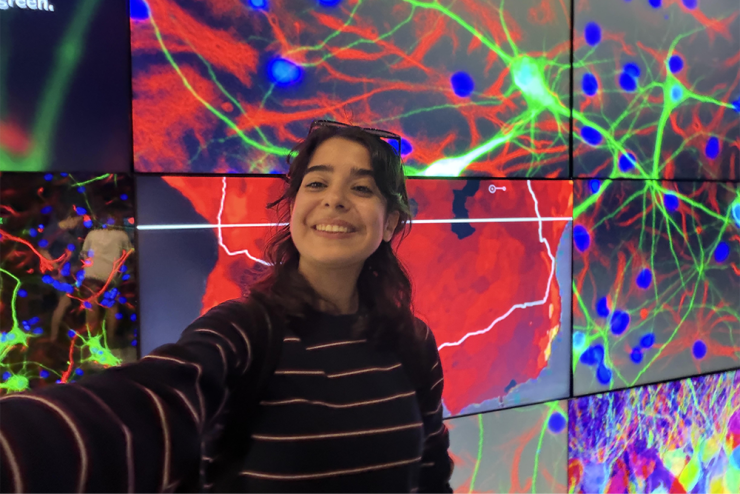

For three international Fulbright scholars at Stony Brook University, arriving from Lebanon and the Republic of Georgia has meant far more than pursuing another degree. It has meant leaving familiar communities behind, finding their footing in new academic and research environments, and throughout it all, considering how the knowledge and relationships they build here might one day benefit the communities they came from.
Miriam Matar, a new master’s student from Lebanon, is just beginning that journey in the Department of Biochemistry and Cell Biology. Mariam Kareli, a medical doctor from the Republic of Georgia, is entering her second year of the master’s program in neuroscience. Sandra Albanna, also from Lebanon, arrived at Stony Brook as a Fulbright master’s student and has now continued into the PhD program in the Department of Neurobiology and Behavior.
Their experiences trace different stages of the Fulbright journey at Stony Brook: the anticipation and uncertainty of arriving somewhere new, the process of building a community on an unfamiliar campus and, eventually, the confidence that emerges from finding support and opportunities within it.
Beginning a New Chapter at Stony Brook
Long before Matar submitted a Fulbright application, international exchange had already shaped how she imagined her future. In high school, she took part in a U.S. Department of State-affiliated program that helped Lebanese students prepare applications for undergraduate study in the U.S. — and though she ultimately stayed in Lebanon for her degree, the experience opened her eyes to a much wider world of educational and cultural exchange.
That curiosity carried her to the U.S. last summer, as part of the Study of the U.S. Institutes Young Women Leaders Program, alongside roughly 60 women from around the world. As they shared stories about their communities, work and the challenges they faced at home, Matar came to see international exchange as a chance to encounter perspectives capable of reshaping her own. When the Fulbright application opened, she saw an opportunity to pursue that same exchange on a deeper scale. Stony Brook appealed to her as she explored faculty publications, her department’s curriculum, seminars and networking opportunities — all of which suggested a graduate experience that extended far beyond the classroom.

Before any of it could begin, however, came the practical reality of moving across the world: securing a visa, gathering and printing documents, and scheduling appointments before departure. When she finally arrived in the U.S., the excitement came laced with homesickness. There were moments when Matar felt out of place, but she’s come to understand those feelings as part of adjusting to a new environment, not proof that she doesn’t belong.
“I know being here is a privilege, and it’s a great opportunity,” she said. “So I always remind myself of that whenever I feel a bit down or a bit homesick.”
Only days into her first semester, the academic possibilities she had imagined from Lebanon were already becoming more tangible. Sitting in an early molecular genetics course, she listened to a familiar concept explained with a depth and nuance she hadn’t encountered back home.
She recalled her excitement, thinking: “Imagine a few weeks into the semester, how much more I’m gonna know about this topic and how I’m gonna approach it very differently.”
That curiosity has carried her beyond the laboratory and classroom. Matar has already browsed student events through SB Engaged, collected brochures at a residence hall field day and planned to explore a longtime interest in film through campus screenings at the Staller Center. In those small acts of exploration, the Stony Brook she once knew only through web pages and application materials is gradually becoming a place she can make her own.
Building a Life and Academic Identity at SBU
A year into her Fulbright experience, Kareli occupies a different point along that arc, one where uncertainty of arrival has given way to clearer research interests, familiar routines and a growing sense of what she hopes to achieve from her time at Stony Brook.
In the Republic of Georgia, Kareli first became drawn to neuroscience while conducting multiple sclerosis research in medical school. After earning her medical degree, she continued her education in Italy through a master’s degree in cognitive science, but when she returned home, one limitation became increasingly apparent: she needed hands-on experience at the lab bench, not just a deeper grasp of the concepts. Fulbright offered a two-year master’s degree, while Stony Brook offered the hands-on research environment she had been seeking.
Her arrival, however, didn’t go as planned: visa delays kept Kareli from reaching the U.S. on schedule, and by the time she landed, many classmates had already found laboratories and settled into the rhythm of the program. She had to catch up academically while still searching for a laboratory of her own. That transition was eased by her program coordinator, faculty and classmates, who helped with everything from coursework questions to a broken laptop to moving between residences.
“Everybody was so helpful here,” she said. “I’m grateful for the hospitality.”
As the practical pieces fell into place, so did her academic direction. Coursework on recent developments in neuroscience, along with broader exposure to genetics — including CRISPR-Cas9 approaches — gradually narrowed her interests toward neurogenetics. She now hopes to pursue the field at the doctoral level. With only one course remaining this semester, Kareli is looking forward to spending more of her second year in the laboratory, sharpening her skills in electrophysiology and stereotactic surgery.

Her life outside the lab has taken root too. She has developed an affection for Port Jefferson, where she enjoys buying ice cream and wandering the shops, and has joined Pink Glove Boxing, a women’s boxing club that offers another way to experience campus beyond her academic program.
From Fulbright Master’s Student to PhD Scholar
If Matar’s story is still unfolding through first impressions and Kareli’s through the gradual formation of an academic life, Albanna’s shows how sharply that path can shift once it’s underway.
Her path to Fulbright emerged during a period of profound upheaval in Lebanon, when political and economic instability deepened her interest in mental health and, eventually, the biology behind psychiatric disorders. The questions fascinated her, but Lebanon’s limited research resources made them hard to pursue.
Then she came across a Fulbright flyer, and after a quick internet search, a path toward the research experience she wanted began to take shape. She found a Stony Brook lab studying post-traumatic stress disorder and emotional dysregulation — work closely aligned with her own interests — and applied.

Once selected, her coursework exposed her to the complexity of psychiatric disease and the many biological and environmental factors that shape it, deepening her interest in the field.
Though challenging, she said, the experience “increased my passion and motivation” to search for new ways of approaching psychiatric disease and, eventually, to contribute another perspective to the field.
By the end of her master’s program, Albanna had planned to return to Lebanon and spend time with her family after two years away, but those plans changed as circumstances in the region evolved and consular services in the U.S. Embassy in Beirut were suspended. Her department, Stony Brook University and Fulbright/U.S. Department of State staff worked together to arrange for her to begin her PhD over the summer, allowing her to continue her studies without interruption. She credits that support, along with the mentors and colleagues she had come to know during her master’s program, with helping her move forward despite circumstances she could not control.
“It wasn’t the easiest period,” Albanna said. “But I’m still grateful for the opportunity that I’m able to learn and continue graduate school. Because at the end of the day, that is the thing I’m passionate about.”
Outside the lab, she has found an unexpected sense of familiarity in Port Jefferson, where the coastline and views of the water remind her of home.
Looking Ahead and Paying It Forward
All three scholars credit support from university offices, their departments, mentors, colleagues, Fulbright staff and Ashley Staples, director of External Fellowships, with helping them navigate the transition.
For Staples, that relationship is reciprocal: while Stony Brook helps Fulbright scholars find their footing, the scholars also bring their own strengths and contribute to the university. “The scholars Stony Brook hosts through the Fulbright Foreign Student Program are always of such excellent caliber and just genuinely great humans,” she said. “They contribute to their programs and the campus from their first step all the way to graduation.”
That exchange continues to shape Matar, Kareli and Albanna in different ways. Although each is at a different point in the journey, their stories circle back to the same idea: studying in another country sharpens how they understand others and shapes how they’ll carry that understanding forward.
By the end of her program, Matar hopes to continue in academic research, potentially as a professor in Lebanon, bringing home not just scientific knowledge but the adaptability that comes with building a life somewhere new. Kareli wants to establish a School of Molecular Medicine in Georgia, creating stronger research and educational opportunities for students who might otherwise conclude — as she once did — that advanced scientific training requires leaving home. Albanna plans to continue studying the neurobiology of psychiatric disorders, carrying forward the same ambition that first brought her to Fulbright: skills and experience that could one day serve the community in Lebanon where her questions first took shape.
Lastly, when asked what they would tell another student standing where they once stood, all three landed on the same answer: Go!
“Always believe that you belong to the place you’re headed to,” Matar said, acknowledging that international students may inevitably experience moments when they question whether they made the right choice or truly belong where they have landed. “Take every new journey with an open, full heart.”
Kareli’s advice was more practical — international students coming to Long Island, she noted, might want to learn to drive if they’re used to places where walking or public transit covers daily life — but her larger point was simpler: Don’t let unfamiliarity stop you. “Apply,” she said. “Just do it.”
Albanna’s reflection traced the distance she’d traveled since first seeing that Fulbright flyer in Lebanon: “The limits that you once thought for yourself aren’t as fixed as they seem, and you’d be able to achieve more than you thought you’d once be able to do.”
Students inspired by their journeys can find support through the Graduate School, which assists graduate students across their academic experience, and the Office of External Fellowships, which helps students pursue nationally and internationally competitive awards, including Fulbright.


Add comment