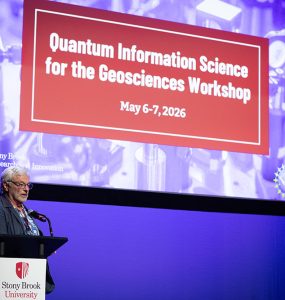
Researchers from across academia, government and industry gathered at Stony Brook University for the Quantum Information Science for the Geosciences Workshop.
Since being selected by NASA for the Artemis moon research team, Professor Timothy Glotch has quickly emerged as a sought-after expert in lunar science.
Timothy Glotch, professor and chair of the Department of Geosciences at Stony Brook University, will be a participating scientist with NASA as part of Artemis‘ first lunar surface science team. Glotch is among 10...
Recent research by faculty from Stony Brook University’s Department of Geosciences analyzed carbonaceous asteroid samples from Bennu, an asteroid visited by NASA’s OSIRIS-REx mission. It revealed the chemical...
Kristen Norberg — the URECA researcher of the month for January — is a junior double-majoring in geology and earth and space sciences. She has been participating in research since September 2024 in the Vibrational...
Stony Brook University planetary scientist Timothy Glotch leads a US research team with access to rare lunar materials collected by China’s Chang’e-5 mission.
Two Stony Brook University geosciences professors are part of a consortium that has received $50 million from the U.S. National Nuclear Security Administration
Stony Brook University's Weisen Shen and a small team of researchers braved one of the planet’s most remote locations in search of climate change answers.
Victoria Castle — the URECA Researcher of the Month for November — is a geology major who has been doing research since January 2023 under the mentorship of Marine Frouin, assistant professor in the Department of...
Nandita Kumari, graduate student in the Stony Brook University Department of Geosciences, has been awarded an Amelia Earhart Fellowship from Zonta International
Three Stony Brook University professors have been awarded a combined $1.6 million in funding from the National Science Foundation to support ongoing research
The Moon’s south polar region is of special interest to scientists because of the occurrence of water ice in the permanently shadowed regions (PSRs) around it. Craters in this region are scientifically important because...
An international team of researchers, including SBU's Jason Lewis, has reached the conclusion that humans may have arrived in Europe about 10,000 years earlier than originally thought.
Researchers in the Luminescence Dating Research Lab study the luminescence properties of minerals and applications of luminescence dating techniques with a focus on human evolution.
The EarthBus Partnership will recruit and mentor students at high schools with large populations of underrepresented students, bringing awareness of geoscience careers.